
Impacting ‘Āina
Prioritizing land for parking means less land for housing, jobs, food, and more.
Land developed for parking accumulates across our communities, reducing the space available for other uses. Hawai‘i has plenty of parking. In fact, there are 4.5 million parking spaces statewide covering 1.5 billion square feet, or 53 square miles. That’s roughly 35 times the size of Waikīkī, or 3 to 4 spaces for every vehicle in the state.

Parking may not be immediately accessible or in your ideal location, but that doesn’t mean it’s not there. In a state with finite land resources, we must ask whether the best use of that land is for parking — a thought that is often overlooked. Parking for the People suggests increased parking supply isn’t the answer; managing demand more effectively is.
In places where we historically have mandated parking, we often end up with significant gaps between homes, jobs, and other amenities. In some cases, more area on a property is dedicated to parking rather than the actual destination or attraction that brings people to the location.

Some of our most accessible and attractive neighborhoods are dominated by parking. In the map to the right, you can see how much of these neighborhoods is designated for parking – not housing, not stores, not schools or parks. In areas such as Kailua Town (33%) and Downtown (27%), a substantial amount of land is used for parking. Other O‘ahu neighborhoods have similar percentages, including Kapahulu (25%), Ala Moana (44%), Dillingham/Iwilei (38%), Kaimukī (17%), Mōʻiliʻili (27%), and Waikīkī (24%). That’s a lot of space that could be used for other community needs.

33% of land in Kailua is used exclusively for parking.
Increasing Cost of Living
The hidden costs of prioritizing vehicles.
Many in the community believe parking should be provided as a natural component of any new development or transportation project. With new housing projects, it is considered essential, like bathrooms, and many insist on it during community processes and agreements. In other cases, more parking is demanded when new road designs are implemented. Unfortunately, the addition of parking spaces is one of the more expensive components of building new homes or businesses. This means that housing and commercial space costs more to build, and everyone pays to cover that cost, even if it remains unused or undesired. Not only that, but private car ownership costs roughly $11,000 per year, taking more money out of consumers' pockets.
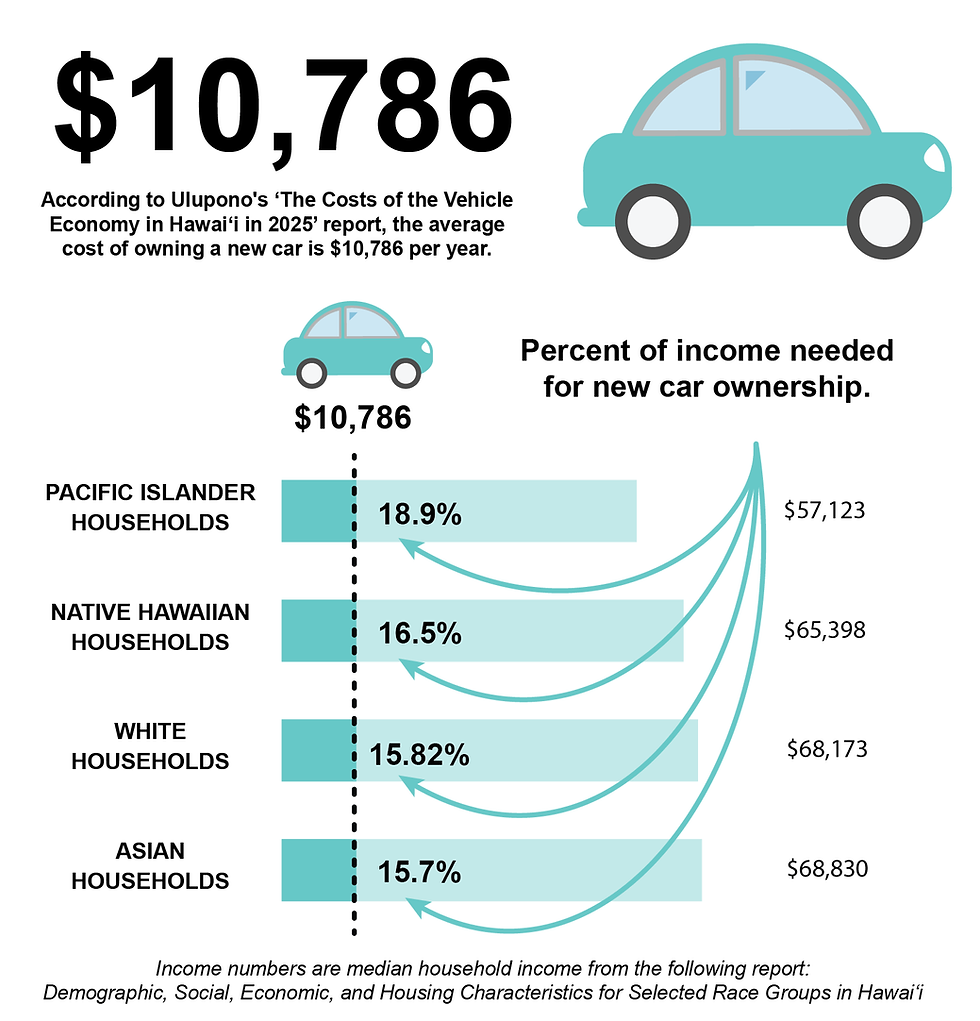
How does parking make housing more expensive?
Construction costs range from $4,200 per space in a surface lot to $60,400 per space in a free-standing parking garage. Construction and ongoing carrying costs are passed on to Hawai‘i's residents, businesses, and visitors through higher rents and housing prices, regardless of their use. That’s between $226 and $511 (in 2025 dollars) per unit added to the cost of monthly rent, or an additional $100,000 per 2-bedroom house or condo purchased in Honolulu.

Prioritizing land for parking means less land for housing, jobs, food, and more.
How does parking make business more expensive?
Parking impacts commercial businesses. More parking results in higher rents for commercial space, as the cost of that space is inflated by parking construction and reduced development scale. This is passed on to customers to help tenant businesses succeed. Parking costs mean higher prices – about 1% of annual retail sales or about the cost of a week’s worth of groceries.

How does parking make government budgets more costly?
Parking costs that are not covered by user fees create a burden on local government budgets. For example, the City and County of Honolulu loses an estimated $4-5 million per year on public parking garages and street meters. Since these costs aren’t covered by the drivers using the spaces, every taxpayer ends up paying the bill.
Honolulu loses $4-5 million annually operating public parking garages and street meters

Limiting Parking Access
Prioritizing free or cheap parking for drivers leads to less available parking and more circling.
When parking is free or too cheap, demand increases, leaving most (if not all) spaces constantly full. We see this on our public streets where limited curb space is used for long-term car storage.
The incentive to move is limited, creating an ongoing perception that there are never enough spots. It also leads to more people circling the block to find other available spaces, increasing traffic congestion. Under-priced parking typically increases vehicle trips by 10 to 30%, meaning that one to three cars around you are looking for parking.


Source: Ben Angarone, Civil Beat, 2023
The same holds true for places like beaches and trailheads. Managing street parking more effectively to keep availability levels at 15% during peak hours would ensure kamaʻāina can find reliable parking, even in high-demand situations. Parking management policies can be structured to give kama‘āina discounts or priority access, which will also reduce the cost impacts of maintaining parking availability in high-demand areas.
Maintaining Unsafe Streets
Prioritizing parking makes streets less safe.
Choosing parking over bike lanes or wider sidewalks increases safety risks for people walking, biking, and taking the bus. For example, this person to the bottom right can walk around the vehicle blocking the sidewalk, but that may not be possible for those in wheelchairs, with mobility issues, or even just on muddy, rainy days. Wide driveways significantly increase the exposure to vehicles turning from multiple directions for a person biking.
Individual business access to parking requires more driveway cuts along a street, which creates more conflict points between cars and people moving through the neighborhood. Streets with parking often have higher crash rates since drivers may be paying more attention to finding parking than looking for people walking nearby.

Street parking takes up space that could be used for sidewalks, trees, benches, parklets, or outdoor restaurant dining. The image to the left shows how some street parking spaces in Honolulu’s Chinatown were transformed into a parklet with a community space that invites people to gather and relax.


How do we counter these issues?
Parking for the People!

Parking for the People refers to a range of resources that challenge long-standing beliefs about parking and reorient programs and policies around people’s needs, particularly when they reduce housing and commercial development, and transportation choices in our communities.
These resources:
-
Prioritize daily transportation needs over private vehicle storage
-
Support diverse transportation choices
-
Ensure public parking supports our communities more effectively
-
Improve the parking access and experience for drivers, based on actual demand
-
Optimize land uses more effectively and for more community needs